
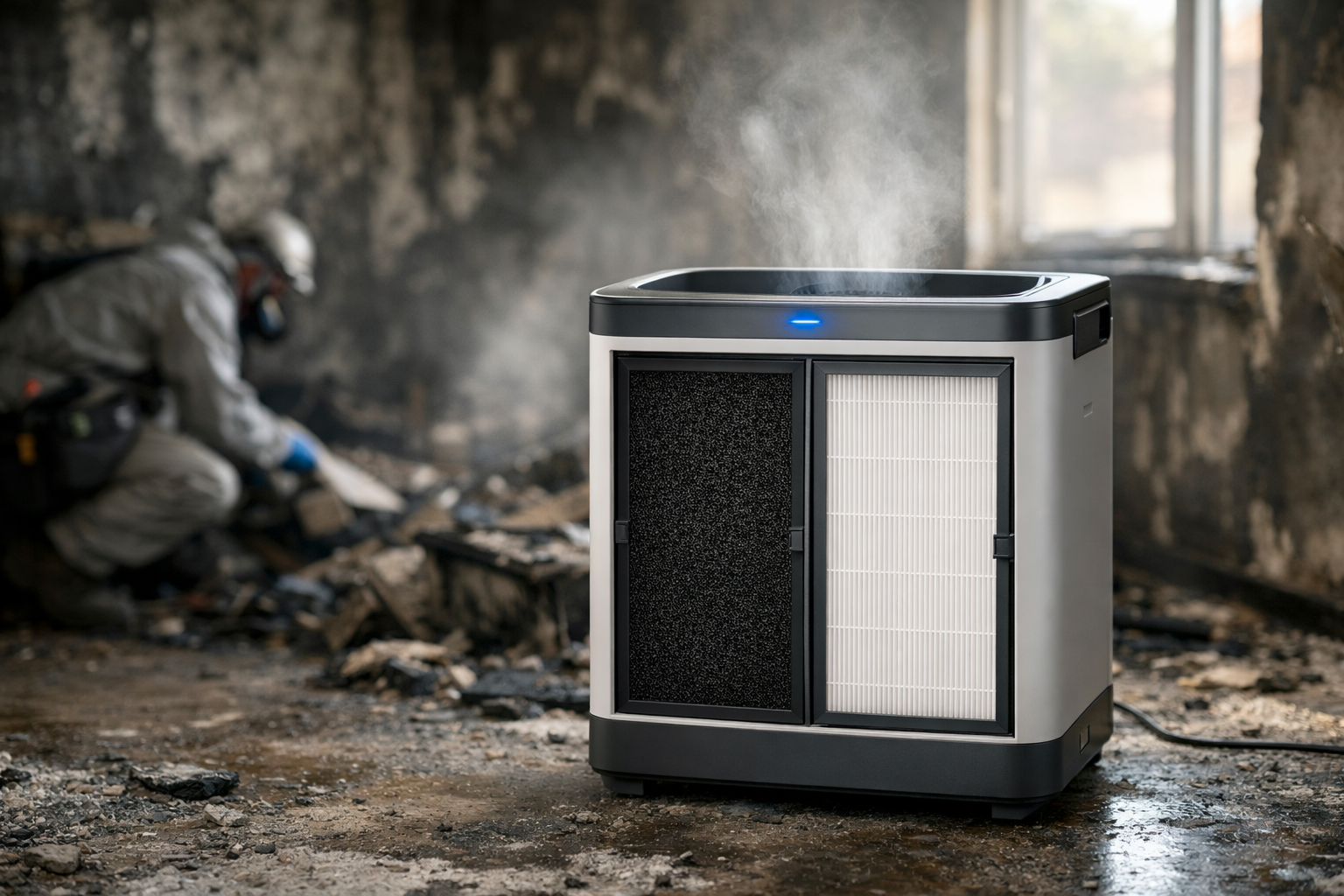
After a house fire, flood, or wildfire, the air inside a damaged building carries more than a bad smell. It holds soot particles, mold spores, and volatile organic compounds that a standard vacuum cannot touch. Picking the right air purifiers for this job means matching filter technology to the exact contaminant you face.
This post breaks down which purifier types work against smoke, mold, and chemical off-gassing. You will learn what CADR ratings mean, when a HEPA unit falls short, and how to find equipment or providers on our directory.
Why Post-Disaster Air Differs From Everyday Indoor Air
Post-disaster air contains a mix of solid particles and gaseous contaminants at the same time. A routine home purifier handles dust and pollen. It rarely addresses the combined load found after damage.
Fire leaves behind fine soot under 2.5 microns. Flooding breeds mold within 24 to 48 hours. Both release gases that particle filters ignore.
Because of this dual threat, one filter type alone rarely clears the space. The right setup usually pairs a particle stage with a gas-absorbing stage.
The Main Types of Air Purifiers Compared
Air purifiers fall into four working categories. Each targets a different contaminant, and knowing the difference saves money on the wrong machine.
1. True HEPA Filters
A True HEPA filter captures 99.97% of particles at 0.3 microns. That covers soot, ash, dust, and mold spores. It is the baseline for any smoke or flood cleanup.
HEPA does nothing for odors or gases. A fire-damaged room may look clear but still smell of smoke after HEPA-only filtration.
2. Activated Carbon Filters
Activated carbon adsorbs gases, odors, and VOCs that HEPA misses. The carbon bed traps smoke smell, mildew odor, and chemical off-gassing from wet drywall.
Carbon depth matters. A thin carbon-coated screen saturates in days. Deep-bed carbon holds several pounds and lasts through a full cleanup cycle.
3. PECO and Photocatalytic Units
PECO uses light-activated catalysts to break down mold, bacteria, and VOCs at a molecular level. Unlike carbon, it destroys contaminants rather than storing them.
PECO units move less air per hour than large HEPA machines. They suit smaller rooms or a finishing stage after bulk particles are gone.
4. Ozone Generators
Ozone generators produce ozone gas to neutralize odors in unoccupied spaces. Restoration crews use them for stubborn smoke smell after fire.
Ozone is unsafe to breathe. Rooms must stay empty during treatment and air out before reentry. Never run one in an occupied home.
Air Purifier Types at a Glance
- HEPA — Best for soot, ash, mold spores, dust. Weak on odors.
- Activated Carbon — Best for smoke smell, VOCs, mildew odor. No particle capture.
- PECO / Photocatalytic — Best for mold and bacteria in small rooms. Lower airflow.
- Ozone Generator — Best for severe odor in empty spaces. Hazardous when occupied.
Matching the Purifier to Your Disaster Type
The contaminant drives the choice. Here is how the main scenarios line up.
Fire and Smoke Damage
Fire cleanup needs both HEPA and deep-bed carbon. HEPA pulls out soot; carbon absorbs the lingering smoke odor. Crews sometimes finish with an ozone treatment in vacant rooms.
Skip a carbon-free purifier here. It will circulate clean-looking air that still reeks of smoke.
Flood and Water Damage
Flood recovery calls for HEPA plus carbon to catch spores and musty gases. Run the purifier alongside dehumidifiers to stop mold from returning.
A PECO unit adds value once bulk moisture is gone. It targets airborne mold and bacteria in the final drying stage.
Wildfire Smoke Infiltration
Wildfire smoke drives fine PM2.5 indoors, so CADR is the number to check. Pick a HEPA unit rated for your room size in square feet.
Carbon helps here too, since wildfire smoke carries irritant gases beyond particles.
How to Read CADR and Room Coverage
CADR (Clean Air Delivery Rate) measures how fast a purifier cleans a room, in cubic feet per minute. Higher CADR clears larger spaces faster.
Follow these steps to size a unit correctly:
- Measure the room’s square footage.
- Match a purifier rated at or above that footage.
- For heavy smoke, choose a unit rated for double your room size.
- Check air changes per hour — aim for 4 to 5 during active cleanup.
An undersized purifier in a large fire-damaged living room may run for days with little result. Correct sizing shortens the cleanup and lowers rental cost.
Portable Units vs. Provider-Grade Equipment
Consumer purifiers work for a single bedroom or light haze. Full-scale damage calls for restoration-grade machines.
- Consumer units — 200 to 400 CADR, quiet, good for one room or maintenance.
- Restoration air scrubbers — 500 to 2,000 CFM, stackable filters, built for gutted structures.
Air scrubbers used by crews often include a pre-filter, HEPA stage, and carbon stage in one housing. That layered build handles the mixed load a single filter cannot.
Finding the Right Equipment or Provider on Restoration Locator
Our directory connects you with crews that carry the correct air purification setup for your damage type. You do not have to guess which filter combination fits.
Use these directory features to narrow your search:
- Filter listings by location to find crews near the damaged property.
- Sort by damage type such as fire, water, or mold remediation.
- Check reviews for notes on odor removal and equipment used.
- Compare providers that list HEPA air scrubbers and carbon filtration.
Matching a provider’s equipment to your contaminant prevents a second, costly round of cleanup.
Common Mistakes to Avoid
Two errors waste money after a disaster. Avoid both to speed recovery.
- Buying HEPA-only for smoke jobs. The odor stays without carbon.
- Running ozone in occupied rooms. The gas harms lungs and must be avoided around people and pets.
A third mistake is skipping the pre-filter. Heavy soot clogs a HEPA stage fast without one, shortening filter life.
Conclusion
The right air purifier depends on your contaminant: HEPA for particles, carbon for odors and VOCs, PECO for mold, and ozone for empty-room odor. Most post-disaster cleanups need a layered setup, not a single filter. Size the unit by CADR and room footage to clear the air faster.
Match your damage type to the right equipment now — browse Disaster Cleanup & Restoration listings on https://restorationlocator.com and find a provider with the filtration your property needs.