
Water damage strikes homes every 14 seconds in the United States, but the hidden threat lies in what happens after the initial incident. Effective moisture control serves as your primary defense against secondary damage that can cost three times more than the original water loss.
Poor humidity management turns a minor leak into a major restoration project. When moisture levels exceed 60% relative humidity, mold growth begins within 24-48 hours.
This guide reveals how strategic moisture management protects your property and why choosing the right restoration professional makes the difference between a quick recovery and months of ongoing problems.
Understanding Moisture Control Fundamentals
Moisture control is the practice of maintaining indoor humidity levels between 30-60% relative humidity while eliminating standing water and dampness from building materials. This range prevents both mold growth and structural damage while maintaining comfortable living conditions.
Three key factors determine moisture control success:
- Relative humidity monitoring – Tracking air moisture content with calibrated hygrometers
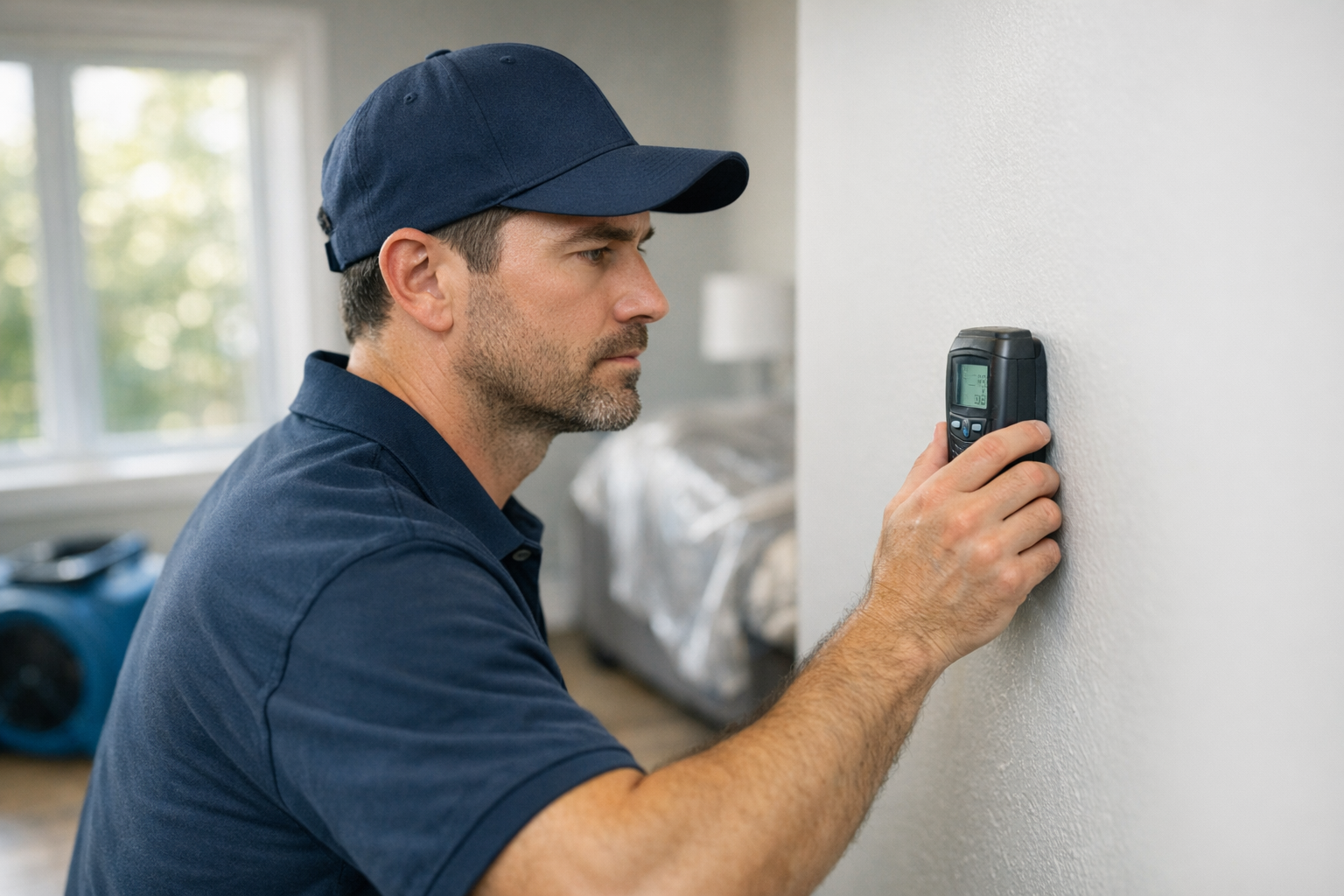
- Material moisture content – Measuring water levels in wood, drywall, and concrete using pin and pinless meters
- Vapor pressure differential – Managing air movement to prevent condensation on cool surfaces
Professional restoration technicians target specific moisture readings based on material type. Wood flooring should read below 12% moisture content, while drywall cannot exceed 15% without risking structural integrity.
The Science Behind Moisture Migration
Water moves through building materials via three mechanisms: bulk flow, capillary action, and vapor diffusion. Understanding these pathways helps predict where secondary damage will occur.
Bulk flow happens when water follows gravity through cracks and gaps. A small roof leak can travel along joists and appear in rooms far from the source.
Capillary action draws moisture into porous materials like concrete and wood. This wicking effect can pull water up walls and into flooring systems weeks after the initial water event.
How Proper Moisture Control Prevents Future Water Damage
Strategic moisture management interrupts the damage cycle before secondary problems develop. When professionals maintain proper humidity levels and dry building materials to industry standards, they prevent 85% of potential secondary damage.
The most effective prevention occurs during the first 72 hours after water intrusion. This window determines whether a minor incident becomes a major restoration project.
Stopping Mold Growth Before It Starts
Mold spores exist everywhere, but they cannot germinate without moisture. Keeping materials below critical moisture thresholds creates an environment where mold cannot establish colonies.
Different mold species have varying moisture requirements:
- Aspergillus – Grows at 65% relative humidity on dust and debris
- Penicillium – Thrives at 78% humidity on wallpaper and fabrics
- Stachybotrys (black mold) – Requires 90% humidity and cellulose materials like drywall paper
Professional-grade dehumidification systems maintain humidity below 50% during the drying period, preventing all three common mold types from taking hold.
Protecting Structural Integrity
Wood structural members lose strength when moisture content exceeds 19%. At these levels, wood becomes susceptible to rot, insect damage, and dimensional changes that affect the entire building envelope.
Concrete and masonry face different challenges. Excess moisture causes efflorescence, where mineral salts migrate to the surface and create white, chalky deposits that weaken the material over time.
Professional Moisture Control Equipment and Techniques
Qualified restoration professionals deploy specific equipment combinations based on the type of water damage and affected materials. The right equipment selection determines both drying speed and thoroughness.
Dehumidification Systems
Two main dehumidifier types address different moisture conditions:
Refrigerant dehumidifiers work best in warm environments above 65°F and high humidity conditions. These units can remove 150+ pints of water daily from the air.
Desiccant dehumidifiers excel in cool conditions and low humidity situations. They use silica gel wheels to absorb moisture and can operate effectively at temperatures as low as 33°F.
Professional technicians calculate grain depression – the difference between incoming and outgoing humidity levels – to monitor drying progress and adjust equipment placement.
Air Movement and Ventilation
Strategic air circulation accelerates moisture removal from both air and materials. Proper airflow patterns create evaporation at material surfaces and transport moisture to dehumidification equipment.
Axial fans move large volumes of air at low pressure, ideal for general circulation. Centrifugal fans generate high pressure for directed airflow into wall cavities and tight spaces.
The most effective drying occurs with one air mover per 100 square feet of affected area, positioned to create overlapping airflow patterns without dead zones.
Monitoring and Documentation for Long-term Prevention
Successful moisture control requires continuous monitoring and detailed documentation. This data proves materials have reached safe moisture levels and provides baseline readings for future reference.
Daily Moisture Readings
Professional technicians take moisture readings at the same locations daily, tracking drying progress across different materials. This documentation becomes crucial for insurance claims and warranty purposes.
Moisture meters must be calibrated to specific gravity settings for each material type. Hardwood flooring requires different settings than softwood framing, and drywall readings differ from concrete measurements.
Temperature and humidity readings are recorded every four hours to track environmental conditions and equipment performance. This frequency captures daily fluctuations that could impact drying effectiveness.
Psychrometric Calculations
Advanced moisture control involves psychrometric analysis – the study of air and water vapor relationships. These calculations determine the maximum moisture removal capacity under current conditions.
Grain weight measurements track actual moisture content in pounds per pound of dry air. When grain depression reaches 30+ grains, dehumidification operates at peak efficiency.
Choosing the Right Restoration Professional
Effective moisture control depends on technician knowledge and equipment quality. The wrong approach can extend drying times and increase secondary damage risks.
Look for restoration companies with Institute of Inspection, Cleaning and Restoration Certification (IICRC) credentials. These technicians understand moisture science and follow industry standards for drying procedures.
Ask potential contractors about their moisture monitoring procedures. Companies that take readings twice daily and provide detailed documentation typically achieve better outcomes than those with minimal tracking.
Equipment Standards and Capacity
Professional restoration requires commercial-grade equipment sized appropriately for the affected area. Residential dehumidifiers cannot handle the moisture loads from significant water damage.
Quality restoration companies own their equipment rather than renting, allowing immediate response and consistent maintenance. Equipment age matters – dehumidifiers lose efficiency over time and require regular calibration.
When evaluating restoration providers on https://restorationlocator.com, check reviews for mentions of equipment quality and response time. These factors directly impact moisture control effectiveness.
Regional Considerations for Moisture Control
Climate conditions affect moisture control strategies and equipment selection. Restoration techniques that work in Arizona desert climates may fail in Florida humidity.
Coastal areas require desiccant dehumidification during certain seasons when outdoor humidity exceeds 80%. Refrigerant units cannot remove moisture effectively when outdoor conditions approach saturation.
Cold climate restoration faces unique challenges. Heating costs and frozen pipes complicate moisture control efforts during winter months. Technicians must balance drying speed with energy costs and secondary damage prevention.
Seasonal Variations
Summer moisture control benefits from lower relative humidity and higher temperatures that accelerate evaporation. Equipment operates more efficiently and drying times decrease.
Winter restoration requires supplemental heating to maintain optimal drying conditions. Cold air holds less moisture, reducing dehumidifier efficiency and extending drying timelines.
Spring and fall present moderate conditions but variable weather patterns. Restoration professionals must adapt to changing outdoor humidity and temperature fluctuations that affect indoor drying.
Cost Benefits of Effective Moisture Control
Proper moisture management during initial restoration prevents costs that can exceed the original damage by 300-400%. These savings come from avoiding mold remediation, structural repairs, and content replacement.
Mold remediation alone costs $15,000-$30,000 for moderate contamination. This expense disappears when moisture control prevents initial mold growth.
Insurance companies recognize these cost benefits and work with restoration professionals who demonstrate proper moisture control procedures. Claims settle faster and coverage disputes decrease when contractors provide thorough documentation.
Property Value Protection
Homes with proper moisture control during restoration maintain their market value. Properties with hidden moisture problems or previous mold issues can lose 10-25% of their value.
Effective moisture control creates a complete restoration that returns properties to pre-loss condition. This outcome protects both immediate living conditions and long-term investment value.
Proper moisture control prevents future water damage by eliminating conditions that allow secondary problems to develop. Professional restoration companies that follow industry standards for humidity management and material drying create the foundation for long-term property protection.
When water damage strikes your property, the restoration professional you choose determines whether moisture control succeeds or fails. Browse qualified Disaster Cleanup & Restoration professionals on https://restorationlocator.com to find certified technicians who understand the science of moisture management and have the equipment to protect your investment.