
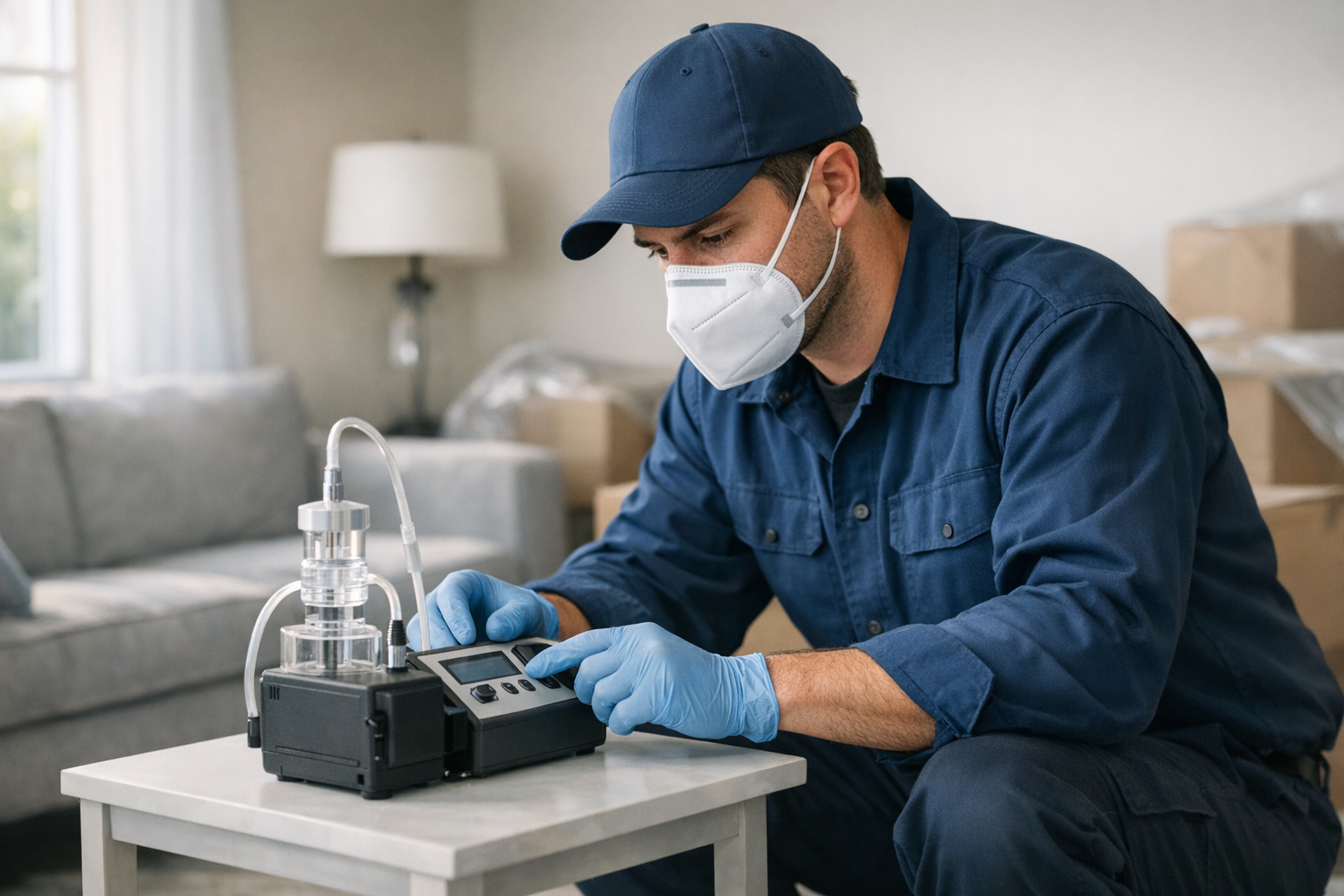
Hidden contaminants can remain in your indoor air long after restoration work appears complete. Air quality testing provides scientific validation that your space is truly safe for occupancy.
Property owners who skip post-restoration air sampling risk exposing occupants to lingering mold spores, chemical residues, and other harmful particles. This testing serves as your final checkpoint before reoccupying restored spaces.
Why Air Quality Testing Matters After Restoration Work
Restoration projects address visible damage but microscopic threats often persist in the air. Water damage creates ideal conditions for mold growth in hidden areas like wall cavities and ductwork.
Fire restoration involves extensive chemical cleaning that can leave residual particles suspended in indoor air. Smoke damage penetrates porous materials and continues releasing contaminants weeks after the initial incident.
Professional testing detects these invisible hazards at concentrations that pose health risks. The process measures specific contaminant levels against established safety standards.
Common Post-Restoration Air Contaminants
- Mold spores – Released during demolition and cleanup of water-damaged materials
- VOCs (Volatile Organic Compounds) – Emitted from new building materials and cleaning chemicals
- Particulate matter – Fine debris from construction and renovation activities
- Chemical residues – Cleaning agents and antimicrobial treatments used during restoration
- Asbestos fibers – Disturbed during work on older buildings built before 1980
The Science Behind Post-Restoration Air Quality Testing
Professional air sampling uses calibrated equipment to capture and analyze airborne particles. Technicians collect samples from multiple locations throughout the restored space over specific time periods.
Laboratory analysis identifies contaminant types and measures concentrations in particles per cubic meter. Results compare indoor air quality to outdoor baseline levels and industry safety standards.
Different testing methods target specific contaminants based on the type of damage and restoration performed. Water damage situations require mold spore analysis while fire restoration needs VOC testing.
Testing Methods and Equipment
Air-O-Cell sampling captures both viable and non-viable particles for comprehensive mold analysis. This method provides the most complete picture of airborne contamination levels.
Real-time particle counters measure dust and debris concentrations during active restoration work. These devices provide immediate feedback on air quality conditions.
VOC testing cartridges collect chemical vapor samples over 8-24 hour periods. Extended sampling captures fluctuating chemical emission patterns from building materials.
Timing Your Air Quality Testing
Testing timing affects accuracy and usefulness of results. Samples collected too early may show elevated levels from ongoing restoration activities rather than permanent contamination.
Most restoration professionals recommend waiting 24-48 hours after work completion before testing. This allows temporary dust and particles to settle while revealing persistent contamination.
Weather conditions also influence testing accuracy. High humidity can suppress mold spore release while strong air currents may dilute contaminant concentrations artificially.
Pre-Testing Preparation Steps
Close all windows and exterior doors 12 hours before sampling begins. This prevents outdoor air from diluting indoor contaminant levels and affecting accuracy.
Run HVAC systems normally during the pre-testing period. Testing should reflect actual living conditions rather than artificially controlled environments.
Avoid using air purifiers, ozone generators, or other air treatment devices during the 24 hours before testing. These devices can mask contamination that would be present during normal occupancy.
Understanding Your Test Results
Laboratory reports show contaminant levels measured against specific reference standards. Mold spore counts compare indoor concentrations to outdoor baseline samples collected simultaneously.
Results indicate whether your space meets safety standards for reoccupancy. Elevated readings require additional remediation before the area becomes safe for normal use.
Professional interpretation helps property owners understand result implications. Some contaminants pose immediate health risks while others create long-term exposure concerns.
Reading Mold Test Results
Spore counts below outdoor levels indicate successful remediation with minimal contamination risk. Most spaces show some mold presence since spores exist naturally in outdoor air.
Indoor levels exceeding outdoor counts by 10x or more suggest ongoing contamination sources requiring additional remediation work.
Presence of indoor-specific mold types like Stachybotrys or Chaetomium indicates water damage areas that need further attention regardless of spore counts.
When Testing Reveals Problems
Failed air quality tests require additional remediation before spaces become safe for occupancy. The specific contaminants detected determine appropriate corrective actions.
High mold spore counts may require additional cleaning of HVAC systems and replacement of porous materials. Chemical contamination often needs specialized air scrubbing or extended ventilation periods.
Re-testing after corrective work confirms that remediation efforts successfully addressed contamination issues. Multiple test failures may indicate hidden contamination sources requiring more extensive investigation.
Common Remediation Steps
- Source identification – Locate remaining contamination sources through visual inspection and moisture testing
- Additional cleaning – Perform targeted remediation in areas showing elevated contaminant levels
- HVAC system treatment – Clean ductwork and replace filters to remove accumulated particles
- Air exchange – Increase ventilation rates to dilute and remove airborne contaminants
- Verification testing – Confirm successful remediation through follow-up air sampling
Choosing Qualified Testing Professionals
Independent testing companies provide unbiased results since they have no financial interest in remediation outcomes. Avoid using the same company for both restoration work and air quality verification.
Look for technicians with industry certifications from organizations like the Indoor Air Quality Association (IAQA) or American Board of Industrial Hygiene (ABIH). These credentials demonstrate specialized training in air sampling procedures.
Qualified professionals explain testing protocols, interpret results clearly, and provide written recommendations for any necessary corrective actions. They should also coordinate with your restoration contractor to ensure proper timing.
Questions to Ask Testing Companies
- What certifications do your technicians hold for air quality testing?
- Which laboratory do you use for sample analysis and what are their accreditations?
- How many sample locations will you test based on my space size and layout?
- What is your typical turnaround time for receiving laboratory results?
- Do you provide written interpretation of results and remediation recommendations?
Cost Considerations and Value
Air quality testing typically costs $300-800 depending on property size and number of samples collected. This investment provides peace of mind and protects against much larger health and liability costs.
Insurance policies sometimes cover testing costs when performed as part of documented restoration work. Check with your insurance adjuster about coverage for post-restoration verification testing.
The cost of testing is minimal compared to potential health impacts from contaminated indoor air. Early detection of problems allows for targeted remediation rather than extensive re-work later.
Long-Term Benefits of Clean Indoor Air
Verified air quality protects occupant health and prevents respiratory issues associated with mold and chemical exposure. Clean indoor air is particularly important for children, elderly individuals, and people with compromised immune systems.
Documentation of safe air quality protects property owners from future liability claims related to the restoration work. Test results provide legal evidence that proper remediation standards were met.
Properties with documented clean air quality maintain higher values and avoid disclosure issues during future sales. Buyers increasingly request air quality documentation for previously damaged properties.
Post-restoration air quality testing ensures your restored space is truly safe for occupancy. This final verification step protects your health and investment by confirming that all contamination has been successfully removed.
Browse certified restoration professionals who understand the importance of proper testing protocols. Start your search for qualified providers today.
Sources
- EPA – Mold
- CDC – Facts about Stachybotrys chartarum and Other Molds
- ASHRAE – Standards and Guidelines for Indoor Air Quality
- American Industrial Hygiene Association – Indoor Environmental Quality