
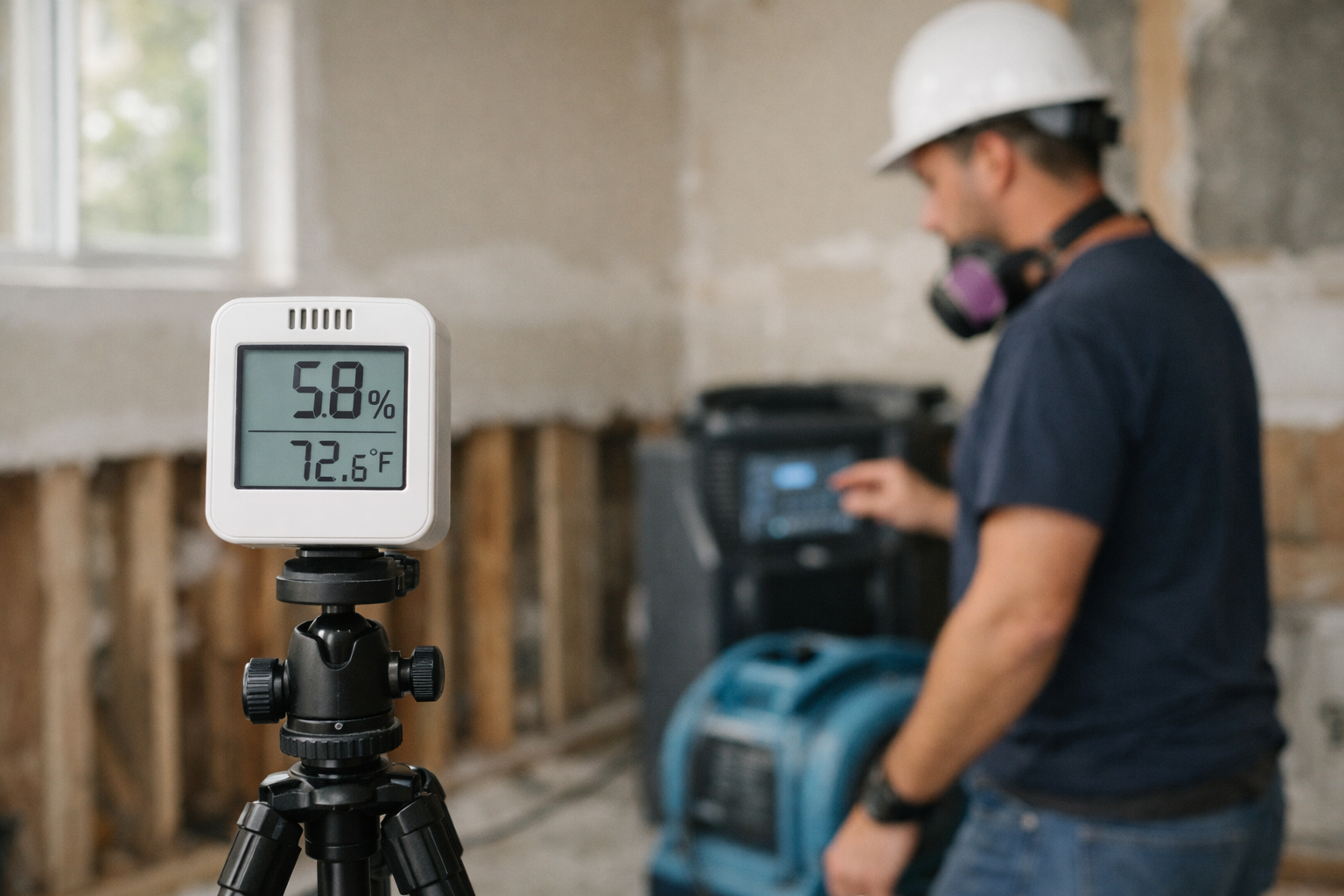
Mold needs three things to grow: moisture, a food source, and time. Humidity sensors attack the first ingredient by measuring water vapor in the air before it settles into drywall, subfloors, and insulation. Catching a spike early is the difference between wiping down a wall and gutting a room.
This post covers how these devices work, where restoration crews place them, and what readings signal trouble. You will learn how sensor data drives faster drying and cleaner mold prevention on real job sites.
What Humidity Sensors Actually Measure
A humidity sensor is a device that reports the amount of water vapor in the air, expressed as relative humidity (RH). Most units combine RH with air temperature, since the two readings together predict condensation risk.
Mold spores activate when surface RH stays above roughly 60% for extended periods. Wood framing, gypsum board, and carpet padding hold moisture long after a leak looks dry to the eye.
Common Sensor Types on Restoration Jobs
- Capacitive RH sensors — measure vapor by tracking changes in a polymer film. Accurate and stable in most drying scenarios.
- Thermo-hygrometers — handheld units that read air temperature and RH at the same spot.
- Pin and pinless moisture meters — read moisture inside materials, not just the surrounding air.
- Data loggers — wireless sensors that record RH every few minutes across days.
A crew rarely relies on one type. Air readings and material readings answer different questions during a dry-down.
Why Humidity Sensors Beat Guesswork in Mold Prevention
Without sensors, a technician judges dryness by touch, which fails badly. A ceiling can feel dry while the cavity above sits at 85% RH.
Consider a burst supply line under a second-floor bathroom. Water travels down wall cavities and pools on the top plate of the floor below. A moisture meter finds that hidden pocket; a hand never will.
A Real Drying Timeline
On a typical Category 1 water loss in a 300-square-foot bedroom, crews aim to pull indoor RH below 50% within the first day. Data loggers confirm whether air movers and dehumidifiers are winning or falling behind.
- Hour 0 — Baseline readings taken at multiple wall points and the room center.
- Hours 1–4 — Equipment set. RH monitored to confirm the dehumidifier is removing more water than the walls release.
- Days 1–3 — Daily logs track a downward RH trend and dropping material moisture content.
- Sign-off — Materials match dry-standard readings from an unaffected reference area.
That reference reading matters. Crews compare wet materials against a dry sample of the same material elsewhere in the building.
Where Crews Place Humidity Sensors
Sensor placement decides whether readings mean anything. Poor placement produces numbers that look fine while mold quietly spreads behind a baseboard.
- Inside wall cavities — near the base, where water settles first.
- Under flooring layers — between subfloor and finished surface.
- In HVAC returns and supply lines — damp ductwork feeds spores to every room.
- Crawl spaces and basements — cool surfaces invite condensation.
- Near exterior corners — cold spots where warm interior air condenses.
A single reading at eye level tells you almost nothing about a slab or a joist bay.
The Dew Point Detail Most People Miss
RH alone can mislead. A cold basement at 55% RH and a warm attic at 55% RH carry very different condensation risk.
Dew point is the temperature at which air releases water onto surfaces. Crews watch dew point spread between air and surfaces to predict where moisture will land. Sensors that report both temperature and RH let a technician calculate this on site.
How Sensor Technology Speeds Mold Prevention
Wireless data loggers changed how restoration crews confirm a job is finished. Instead of one snapshot per visit, a project manager watches trends remotely.
Some systems push alerts when RH crosses a threshold overnight. A dehumidifier that trips a breaker at 2 a.m. no longer costs a full day of stalled drying.
Documentation That Protects You
Continuous logs create a defensible record for insurance claims. Adjusters want proof that materials reached dry standard before walls closed up.
- Time-stamped RH and temperature readings across the full dry-down.
- Material moisture readings against a dry reference.
- Photos paired with each reading location.
This paper trail also shields homeowners. If mold surfaces months later, the log shows the space was verified dry at handover.
Sensor Data vs. Visual Inspection
Both matter, but they answer separate questions. Use them together, never one alone.
- Visual inspection — spots active mold, staining, and warped materials you can see.
- Humidity sensors — reveal hidden moisture before mold appears.
- Visual only — misses cavity moisture until damage is advanced.
- Sensors only — flags moisture but won’t confirm existing growth.
A skilled crew reads both, then decides whether to dry in place or open a wall.
What to Ask a Restoration Provider About Their Sensors
The equipment a company owns tells you how they work. Ask direct questions before hiring.
- Do you use wireless data loggers or single-visit spot checks?
- Will I receive a moisture log with the final report?
- How do you set the dry standard for my specific materials?
- Do you check wall cavities and subfloors, not just air?
- What RH target triggers equipment removal?
Vague answers signal a crew that dries by feel. Detailed answers point to a data-driven approach.
Finding the Right Crew on Restoration Locator
Use the directory to shortlist providers who match your loss type. A few steps narrow the field fast:
- Filter listings by location to find crews who can arrive within hours.
- Check reviews for mentions of documentation and moisture logs.
- Sort by service type to match water damage, mold remediation, or both.
Speed matters here. Mold can start within 24 to 48 hours of a water event, so a nearby crew with sensor equipment gives you a real head start.
Preventive Monitoring for Homeowners
You don’t need a restoration crew to watch humidity year-round. Affordable home hygrometers cost under $30 and catch slow problems early.
Place one in the basement and one near any past leak site. Keep indoor RH between 30% and 50%. Readings that creep past 60% mean it’s time to run a dehumidifier or call for an inspection.
Conclusion
Humidity sensors turn mold prevention from guesswork into measurable work by catching moisture before it becomes damage. Proper placement, dew point awareness, and continuous logging separate a real dry-down from a rushed one. Ask any provider how they measure and document dryness before you hire.
Ready to find a crew with the right equipment? Browse Disaster Cleanup & Restoration listings now at https://restorationlocator.com and start your search today.