
When a wildfire forced 180,000 people to evacuate Sonoma County in 2017, many families lost track of each other within minutes. Cell towers overloaded. Roads closed. Parents could not reach children at school.
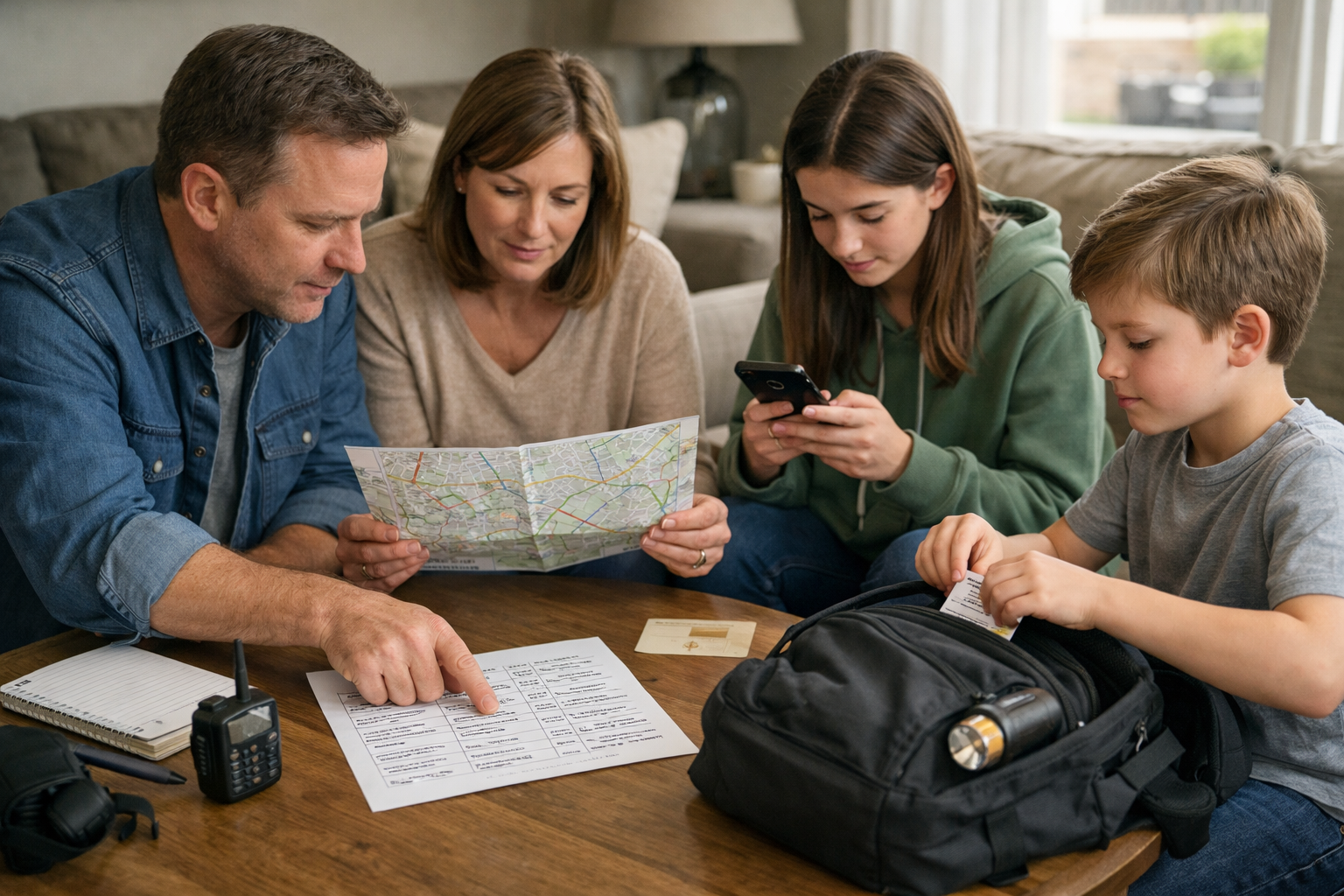
A disaster communication plan prevents that chaos. It tells every family member who to call, where to meet, and what to do when normal phone lines stop working. This post walks you step by step, with real scenarios that show why each piece matters for family safety.
What a Disaster Communication Plan Is and Why It Fails Without Practice
A disaster communication plan is a written set of contacts, meeting points, and backup methods your household uses when a disaster separates you. It works only when every member knows it by memory, not by paper alone.
The biggest breakdown happens with cell networks. During Hurricane Sandy, roughly 25% of cell sites across 10 states went down. Calls failed, but text messages still slipped through on the same dead-looking network.
Key takeaway: texting uses less bandwidth than voice calls. Plan to text first during a disaster, not call.
Step-by-Step: Build Your Family Communication Plan
Follow these steps in order. Each one closes a gap that trips up unprepared households.
- Name one out-of-state contact. Local lines jam during regional disasters. A relative in another state can relay messages between separated family members.
- List every phone number and email on paper. A dead battery erases your contacts. Write numbers on a card each person carries in a wallet or backpack.
- Pick two meeting spots. One near home for a house fire. One outside the neighborhood for evacuations, like a specific library or church parking lot.
- Assign a school and workplace check-in rule. Know each school’s reunification policy. Many districts release children only to pre-authorized adults.
- Set a text-message code. Short codes send faster. Agree that “OK1” means safe at home, “OK2” means safe at meeting spot.
- Store copies in three places. Wallet, glove box, and a shared cloud note everyone can open.
Assigning Roles Before the Emergency
Give each capable family member one job. One grabs the emergency binder. One handles pets. One texts the out-of-state contact.
Confusion costs time when adrenaline hits. Named roles remove the freeze-and-argue moment that families report after real evacuations.
Backup Communication Methods When Cell Service Dies
Cell service is your first tool, not your only one. Layer these backups so one failure does not silence your family.
- SMS text: Sends on congested networks that block calls. Your primary backup.
- Wi-Fi calling apps: Work if power and internet hold, useful during localized fires.
- A battery or hand-crank NOAA weather radio: Receives official alerts when your phone is dead.
- Two-way radios (FRS/GMRS): Connect family members within a few miles, no towers needed.
- A physical note at the meeting spot: Leave a dated message under a rock if you must move on.
During the 2021 Marshall Fire in Colorado, families with two-way radios coordinated their exits while neighbors stood in dead zones. Low-tech tools earn their keep.
Special Planning for Children, Seniors, and Pets
Standard plans assume healthy adults with charged phones. Real households rarely match that picture.
Children
Teach young kids to memorize one phone number and one full name. Practice it as a song. Sew or write the out-of-state contact inside a jacket for kids too young to memorize.
Seniors and Medical Needs
List medications, dosages, and doctors on the contact card. Note any device that needs power, like an oxygen concentrator. Register with your utility’s medical-priority program before a season with outages.
Pets
Many shelters refuse animals. Pre-identify a pet-friendly evacuation point and add it to the plan. Keep a leash and carrier near your exit.
Test the Plan With a Realistic Drill
An untested plan is a guess. Run a drill twice a year, changing the scenario each time.
- Announce a surprise scenario at dinner, like “the road east is closed.”
- Have everyone recite the out-of-state number from memory.
- Send the agreed text code to the out-of-state contact and time the reply.
- Drive to the second meeting spot to confirm it stays reachable.
- Note what broke, then fix it that week.
Families who drill twice recall their meeting point far better than those who read the plan once. Repetition beats intention.
What to Do When Communication Restores After the Disaster
Reconnecting is only the first relief. The next calls decide how fast your home recovers.
Once family safety is confirmed, contact your insurer and a cleanup company before mold or water damage spreads. Water-soaked drywall grows mold within 24 to 48 hours, per public health guidance.
This is where your recovery plan meets your communication plan. Keep restoration contacts in the same binder as your family numbers.
How Restoration Locator Fits Your Plan
Add a vetted cleanup provider to your emergency binder now, not during the panic. On https://restorationlocator.com you can:
- Sort listings by location to find crews near your home.
- Filter by damage type such as flood, fire, or storm.
- Check reviews to shortlist two providers before disaster strikes.
Writing a name and profile link into your plan today saves hours later.
Common Mistakes That Break a Disaster Communication Plan
Avoid the errors that repeat in after-action reports across every major event.
- Relying only on phone calls. Voice networks jam first.
- Storing contacts only in phones. Batteries die within hours.
- Choosing a vague meeting spot. “The park” fails; name a specific gate.
- Never practicing. A plan nobody has rehearsed collapses under stress.
- Forgetting non-drivers. Teens and seniors need a ride plan.
Conclusion
A working disaster communication plan comes down to an out-of-state contact, paper backups, named meeting spots, and regular drills. Layer text and radio backups because cell service fails first. Confirm family safety, then move fast on cleanup to stop damage from spreading.
Add a restoration provider to your plan before you need one. Browse Disaster Cleanup & Restoration listings now at https://restorationlocator.com and pin your top two choices today.
Sources
- Ready.gov – Make a Plan
- Federal Communications Commission – Emergency Communications
- Centers for Disease Control and Prevention – Mold Cleanup and Prevention
- National Weather Service – NOAA Weather Radio All Hazards