
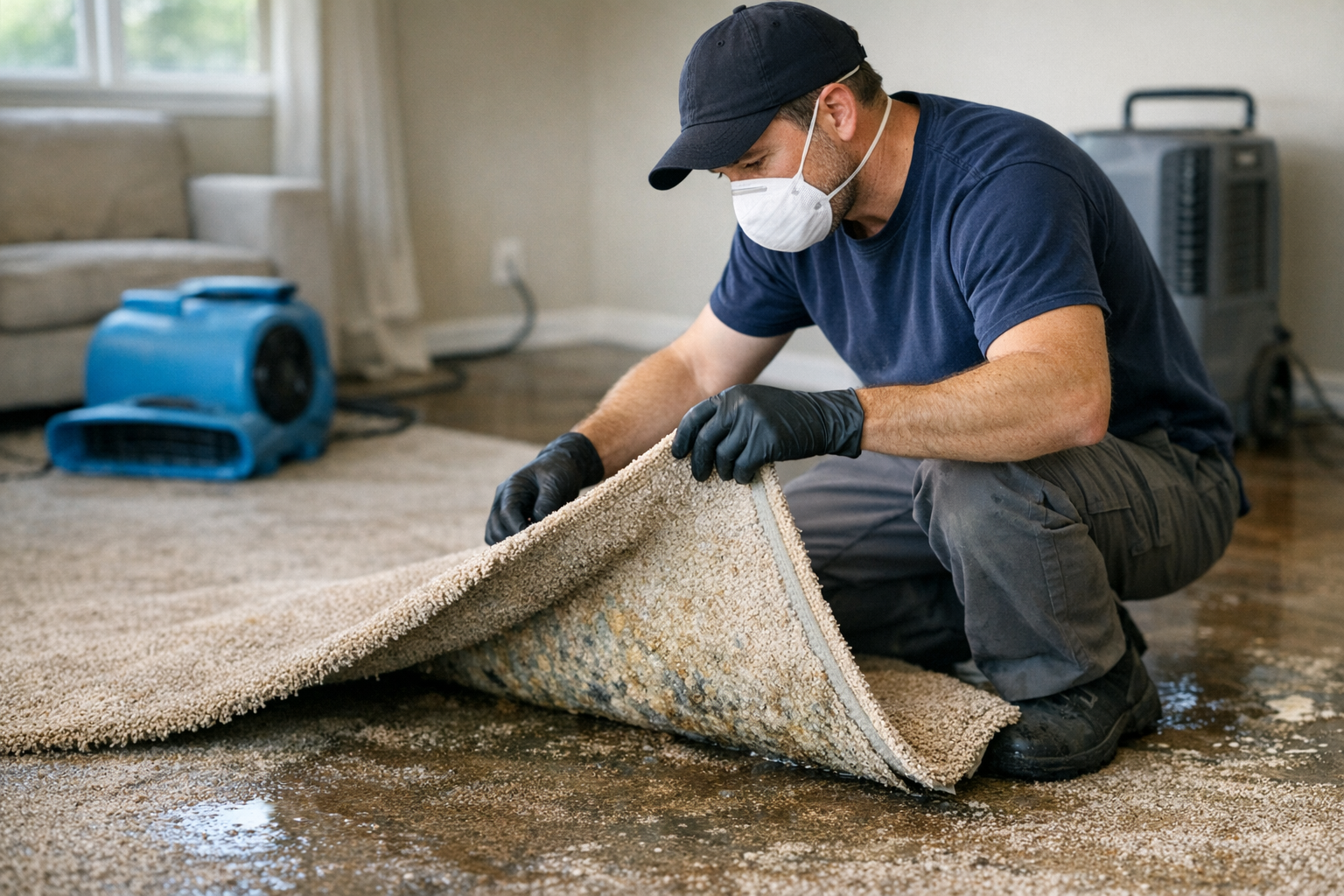
The decision to clean or replace your carpet after a flood comes down to one detail most homeowners overlook: the type of water that soaked it. Clean tap water gives you room to save the carpet. Sewage backup almost never does.
This post breaks down when carpet cleaning makes financial sense after water damage and when replacement is the smarter call. You will see real cost ranges, drying timelines, and the health risks that tip the scale.
The First Question: What Kind of Water Hit Your Carpet?
Restoration crews sort water into three categories. This single distinction drives almost every cleaning-versus-replacement decision.
- Category 1 (clean water): Burst supply line, overflowing sink, rainwater. Carpet is usually salvageable if dried within 48 hours.
- Category 2 (gray water): Washing machine overflow, dishwasher discharge, toilet overflow without solids. Cleaning is possible but the pad usually needs replacing.
- Category 3 (black water): Sewage, river flooding, ground seepage. Carpet and pad both get discarded. No exceptions.
A flooded basement from a backed-up sewer line is Category 3. That carpet goes in the dumpster, even if it looks fine.
Why the 48-Hour Window Matters
Mold begins growing on damp carpet backing within 24 to 48 hours. After that window, spores embed in the jute or synthetic backing where cleaning cannot reach.
A carpet soaked Tuesday and still wet Friday is a mold problem, not a cleaning problem. Time decides the outcome more than the water volume.
Carpet Cleaning vs. Replacement: Cost and Time Compared
Here is how the two paths stack up for an average 200-square-foot room hit with clean water.
Carpet Cleaning Path
- Cost: $150 to $400 for extraction and hot-water cleaning. Add $1 to $2 per square foot if the pad needs replacing.
- Time: 2 to 5 days including drying with air movers and dehumidifiers.
- Effectiveness: High for Category 1 water caught early. Drops sharply past 48 hours.
Carpet Replacement Path
- Cost: $700 to $1,800 for the same room, including new carpet, pad, and installation.
- Time: 1 to 3 weeks once you account for material ordering and scheduling.
- Effectiveness: Total fix. No lingering odor or mold risk when done right.
Cleaning costs roughly a quarter of replacement when the carpet qualifies. The catch is qualification, which depends entirely on water type and response speed.
When Carpet Cleaning Is the Right Call
Cleaning makes sense under a specific set of conditions. Treat this as a checklist, not a hopeful guess.
- The water was Category 1 clean water from a supply line or rain.
- Extraction began within 24 to 48 hours of the spill.
- The carpet is less than 7 years old and in good shape otherwise.
- The subfloor underneath is plywood or concrete, not particleboard.
- No standing water sat long enough to delaminate the backing.
Meet all five and cleaning is worth pursuing. A restoration crew can extract, sanitize, and dry the carpet in place or float it to dry the pad beneath.
The Pad Almost Always Loses
Even when the carpet survives, the foam or rebond pad rarely does. Pad holds water like a sponge and dries slowly.
Most crews cut and replace the pad while saving the top carpet. Budget for this even on a cleaning job.
When Replacement Is the Smarter Decision
Replace the carpet outright in any of these situations. Cleaning a contaminated or aged carpet wastes money and risks your health.
- Sewage or flood water touched it (Category 3). Non-negotiable.
- The carpet stayed wet longer than 72 hours.
- You see or smell mold on the backing or in the room.
- The carpet backing has delaminated, leaving a rippled or bubbled surface.
- The carpet was already worn, stained, or near end of life.
A 12-year-old carpet hit by a washing machine flood is not worth saving. The cleaning cost plus pad replacement approaches the price of new carpet.
The Health Math on Mold
The EPA notes that porous materials soaked with contaminated water should be discarded. Carpet is porous. Once mold colonizes the backing, surface cleaning leaves spores behind.
For households with asthma or allergies, replacement removes the risk entirely. That peace of mind has value cleaning cannot match.
How to Get an Honest Assessment
A reputable restoration crew uses a moisture meter and a thermal camera before quoting. They check the subfloor and pad, not just the carpet surface.
Be cautious of any company that recommends full replacement without testing moisture levels. The reverse is true too: cleaning a Category 3 carpet to save money is a red flag.
Use Restoration Locator to Compare Crews
On restorationlocator.com, you can find local water damage and carpet cleaning specialists by area. Use these steps to narrow your choices:
- Sort by location to find crews that respond inside the 48-hour window.
- Check reviews for mentions of moisture testing and honest assessments.
- Filter listings for providers that handle both extraction and replacement.
A crew that does both has no incentive to push you toward the pricier path.
A Quick Decision Summary
Use this as your fast reference when water hits the floor:
- Clean water, dried within 48 hours, newer carpet → Clean it, replace the pad.
- Gray water, fast response, decent carpet → Clean and sanitize, replace the pad, monitor for odor.
- Any sewage or flood water → Replace carpet and pad.
- Wet past 72 hours or mold present → Replace.
Conclusion
Carpet cleaning saves money when clean water is caught fast and the carpet is newer, costing a fraction of replacement. Sewage, slow drying, mold, or worn carpet all point to replacement instead. The water category and your response time settle the question more than anything else.
Find local water damage and carpet cleaning specialists who test before they quote. Start your search at restorationlocator.com today.