
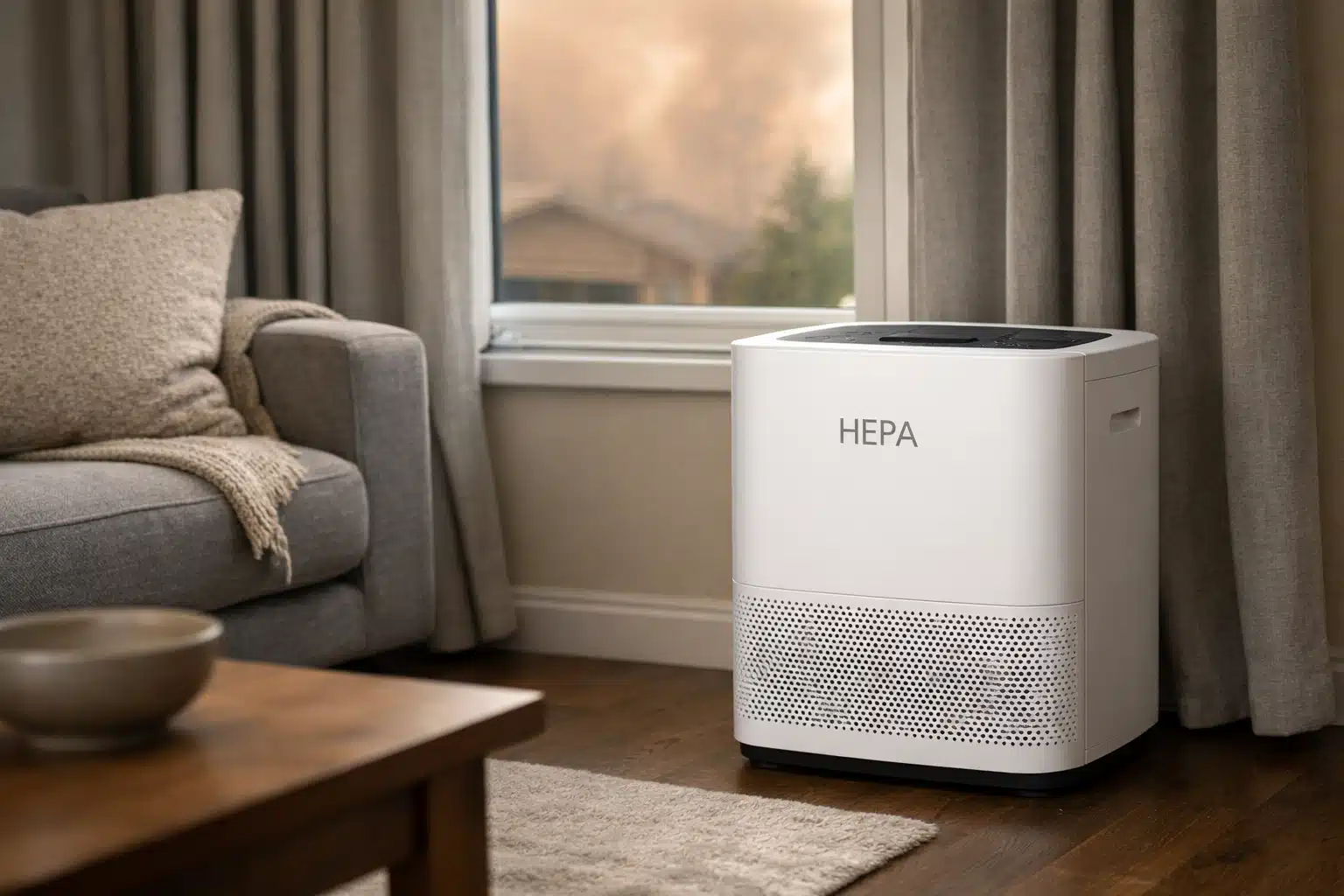
Wildfire smoke can push indoor particle levels 5 to 10 times higher within hours of a nearby burn. That fine particulate, called PM2.5, slips past most household defenses and settles into your lungs. Effective wildfire air quality protection depends on two things working together: filtration that captures those particles and sealing that stops smoke from entering.
This post covers the exact filter ratings, DIY air cleaner builds, and gap-sealing tactics that keep smoke out. You will also learn when smoke damage warrants a restoration crew.
Why Wildfire Smoke Beats Ordinary Home Defenses
Wildfire smoke is mostly PM2.5, particles smaller than 2.5 microns wide. For scale, a human hair measures about 70 microns across.
Standard furnace filters rated MERV 6 or 8 let most of this smoke pass right through. They were built to catch dust and pet hair, not combustion particles.
Smoke also carries volatile organic compounds and gases. Particle filters do nothing for the gases, which is why odor lingers even after visible haze clears.
Filtration Methods for Wildfire Air Quality Protection
Filtration is your first line of defense against smoke that has already entered. The right filter rating determines whether you capture PM2.5 or waste money on airflow.
Choose the Right MERV Rating
MERV 13 is the minimum rating that captures a meaningful share of PM2.5 particles. It traps roughly 85 percent of particles in the 1 to 3 micron range.
Before installing a MERV 13 filter, check your HVAC system’s tolerance. Older furnaces with weak blowers can struggle against the added resistance.
- MERV 8: Catches dust and lint, misses most smoke.
- MERV 11: Captures some fine particles, partial smoke help.
- MERV 13: Traps most PM2.5, the wildfire standard.
- HEPA: Removes 99.97 percent at 0.3 microns, for portable units.
Run a Portable HEPA Air Cleaner
A true HEPA air cleaner sized for the room delivers the strongest indoor particle removal. Match the unit’s Clean Air Delivery Rate to your room square footage.
Place the unit in the room where you sleep and keep doors closed. One well-placed cleaner in a bedroom beats one undersized unit fighting your whole house.
Build a DIY Box Fan Filter
A Corsi-Rosenthal box is a homemade air cleaner made from a box fan and four MERV 13 filters. It moves large volumes of air at a fraction of a store-bought unit’s cost.
- Arrange four MERV 13 filters into a cube shape.
- Seal the vertical seams with duct tape.
- Cut a cardboard base to close the bottom.
- Set a box fan on top, blowing outward.
- Tape the fan to the filter cube and seal all edges.
Check the arrows on each filter and point them inward toward the fan. A single box unit can clean a mid-sized bedroom in under 20 minutes.
Sealing Methods That Stop Smoke at the Door
Sealing prevents smoke from entering in the first place, which matters more than filtration once air is fouled. Most household smoke intrusion comes from door gaps, window frames, and attic penetrations.
Seal Doors and Windows
Door gaps are the largest single entry point in most homes. A quarter-inch gap under an exterior door leaks smoke as fast as a small open window.
- Door sweeps: Fit rubber sweeps to the bottom of exterior doors.
- Weatherstripping: Line door and window frames with foam tape.
- Painter’s tape: Tape window seams shut during heavy smoke days.
- Rolled towels: Block gaps under interior doors to isolate clean rooms.
Address Hidden Air Pathways
Smoke enters your attic and walls before reaching living spaces. Recessed lights, bathroom fans, and range hoods act as smoke chimneys in reverse.
Cap unused vents with plastic sheeting and tape during peak smoke events. Keep bathroom and kitchen exhaust fans off, since they pull outdoor air inward.
Set Your HVAC to Recirculate
Switch your system from fresh-air intake to recirculate mode during wildfire events. Close any manual outdoor air dampers on the unit.
Keep the fan running on recirculate to push indoor air across your MERV 13 filter continuously. This turns your whole HVAC system into a house-wide air cleaner.
Create One Clean Room
A clean room is a single sealed space where you concentrate filtration and reduce smoke exposure. Pick an interior room with few windows and doors.
- Seal every window and door gap in the room.
- Run a HEPA unit or box fan filter inside.
- Keep the door closed and limit foot traffic.
- Avoid candles, frying, and vacuuming, which add particles.
Families with children, older adults, or respiratory conditions benefit most from this setup. One clean bedroom gives everyone a place to breathe during the worst air days.
What to Do After Smoke Damage
Smoke leaves residue on surfaces, inside ductwork, and within insulation long after the fire passes. Odor that returns on humid days signals particles trapped in porous materials.
Light haze usually clears with cleaning and filter changes. Heavy exposure calls for duct cleaning, insulation replacement, and odor treatment beyond household reach.
Signs You Need a Restoration Crew
- Smoke odor persists after weeks of filtration.
- Visible ash or soot coats interior surfaces.
- HVAC ducts carry a burnt smell when running.
- Yellow or gray staining appears on walls and ceilings.
How to Find the Right Provider
Restoration Locator lets you match your situation to qualified crews by location. Use the directory to compare providers before smoke damage worsens.
- Filter by location to find crews near your fire zone.
- Check reviews for smoke and odor removal work.
- Sort by specialty to find duct cleaning and soot removal.
Timing: Act Before the Smoke Arrives
Buy MERV 13 filters and box fans before wildfire season peaks. Supplies vanish within hours once a nearby fire sparks and neighbors rush stores.
Keep two spare MERV 13 filters on hand at all times. Smoke clogs a filter fast, and a saturated filter stops working against fine particles.
Summary and Next Steps
Strong wildfire air quality protection pairs MERV 13 filtration with tight door and vent sealing. A dedicated clean room and a recirculating HVAC system give your household a reliable place to breathe.
When smoke damage outlasts your cleaning efforts, a restoration crew handles ducts, insulation, and odor at the source. Protect your indoor air safety by acting before the next fire, not after.
Browse Disaster Cleanup & Restoration listings at https://restorationlocator.com and find smoke damage help near you.